Getting Started
For help from an AI coding assistant, see Using AI Tools. Rukhanka Animation includes task-specific skills for setup, character animation, scripting, and troubleshooting.
Prerequisites
To use Rukhanka Animation System, you need:
- Unity 2022.3.0f1+
- Unity
Entitiespackage version 1.4.3+ (installed automatically as dependency) - Unity
Entities.Graphicspackage version 1.4.16+ (installed automatically as dependency) - HDRP or URP, with a version compatible with the installed Entities Graphics package
- [Optional]
Netcode for Entitiespackage for network animation synchronization support
Use compatible versions of Unity, Entities, Entities Graphics, and your render pipeline. When upgrading, read Upgrading Rukhanka Animation and check the package requirements before changing an existing project.
Animated Object Setup
Prepare the model's Avatar, create an authoring object in a SubScene, and assign deformation-aware materials. This guide uses the CPU Animator and a Unity Animator Controller as the initial configuration.
Model Importer
Use Unity's model importer to configure the model:
-
Disable Optimize Game Objects. Rukhanka Animation needs the bone GameObjects during baking. Use bone entity stripping afterward to reduce runtime transform entities.

Rig Definition
Rukhanka Animation reads imported skeleton information from the Unity Avatar. For imported models, use the following sequence to ensure the Avatar contains the required skeleton data:
-
In the importer window of your animated model switch
Animation Typeto theHumanoidand pressApply.ImportantThis preparation also applies to imported Generic rigs. Temporarily switching to Humanoid makes Unity populate the skeleton information Rukhanka Animation reads; it does not mean the model must remain a Humanoid rig.
You will get an error during the baking process if avatar rig information is not available to Rukhanka Animation.

-
For Humanoid models, finish the Avatar mapping and leave the animation type set to Humanoid. For Generic models, switch the animation type back to Generic and press Apply.
For a transform hierarchy created in the Editor without an Avatar, see Non-skinned Mesh Animation. Do not use the imported-model Avatar workflow for that case.
Authoring Object Setup
Create the animated authoring GameObject inside an Entities SubScene:
-
Place your animated object inside
EntitiesSubscene. For detailed description of this step refer Entites Package documentation.
-
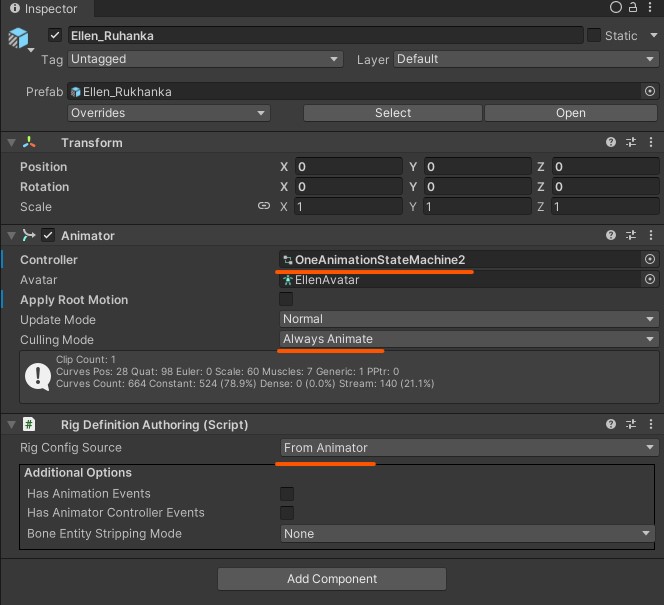
Add Rig Definition Authoring to the animated root, set Rig Config Source to From Animator, and select the CPU animation engine.
-
Add or configure the Unity Animator on the same object. Assign the prepared Avatar and an Animator Controller; one state referencing one clip is enough to start.
-
Set the Animator's Culling Mode to Always Animate. Configure animation culling separately after verifying playback.
Shaders And Materials
Entities Graphics renders the mesh; Rukhanka Animation supplies animation and deformation data. Every skinned material must use a Rukhanka Animation-compatible deformation shader for the active render pipeline. Follow Shaders with Deformations to create one, or start with the shaders included in the samples.

End Of Setup Process
Wait for imports and SubScene baking to complete, then enter Play mode. Confirm that the character animates and the Console has no new baking or shader errors. The runtime controller should advance its state and submit the clip to the animation engine.
If playback fails, check the Avatar and controller assignments, SubScene loading, render-pipeline compatibility, and deformation materials before adding IK, physics, or culling. Blob Inspector can confirm which rigs, controllers, and clips were baked.
IMPORTANT: There is not 100% Unity's Mecanim feature support. Please consult Feature Support Tables for complete information.